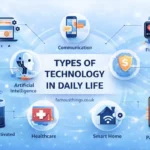
Technology plays a central role in modern life, helping people communicate, work, travel, and manage daily tasks more efficiently. The types of technology in daily life include communication technology, information technology, artificial intelligence, health technology, and transportation systems.
These types of technology in daily life make everyday activities faster, easier, and more convenient by improving productivity, connectivity, and access to essential services.
What Does Technology in Daily Life Actually Mean?
Most people think technology only refers to smartphones, laptops, or the internet. However, the concept is much broader. Technology includes both digital and physical solutions that improve efficiency and convenience.
For example:
- A smartphone helps you communicate and access information
- A washing machine reduces manual labor
- A GPS system helps you navigate accurately
- An ATM allows instant access to money
All these examples show that technology is deeply integrated into daily life in different forms.
Why Technology Has Become Essential in Daily Life
Technology is important because it reduces effort, saves time, and increases productivity. Without technology, even basic tasks would require more manual work and time.
Here is why technology matters:
- It speeds up daily tasks
- It improves communication across distances
- It provides quick access to services
- It reduces human error
- It improves overall quality of life
Modern life is structured around technology, making it a necessity rather than a choice.
Core Types of Technology in Daily Life
1. Communication Technology
Communication is one of the most important types of technology in daily life, as it allows instant connection between people.
Examples:
- Smartphones
- Messaging applications (WhatsApp, Telegram)
- Video conferencing platforms
Daily Life Use:
- Sending messages
- Making voice and video calls
- Attending online meetings
Impact:
Communication technology has removed physical barriers and made global interaction possible in real time.
2. Information Technology (IT)
Information technology deals with storing, managing, and processing data. It supports almost all digital systems used today.
Examples:
- Desktop computers
- Laptops
- Software systems
- Cloud storage platforms
Daily Life Use:
- Office work
- Data storage
- File management
Impact:
IT is the backbone of businesses, education systems, and online services.
3. Internet Technology
Internet technology connects devices globally and enables access to information and services.
Examples:
- Websites
- Search engines
- Online platforms
Daily Life Use:
- Searching information
- Online learning
- Social interaction
Impact:
The internet has made knowledge and services accessible instantly.
4. Artificial Intelligence (AI) Technology
AI technology allows machines to perform tasks that normally require human intelligence.
Examples:
- Voice assistants
- Recommendation systems
- Chatbots
Daily Life Use:
- Personalized suggestions
- Automation
- Smart responses
Impact:
AI improves efficiency, accuracy, and decision-making in everyday activities.
5. Health Technology
Health technology focuses on improving medical care and personal well-being.
Examples:
- Fitness tracking devices
- Telemedicine platforms
- Digital health records
Daily Life Use:
- Monitoring physical activity
- Online consultations
- Health tracking
Impact:
It improves access to healthcare and supports early diagnosis.
6. Transportation Technology
Transportation technology improves the movement of people and goods.
Examples:
- Cars and electric vehicles
- Navigation systems (GPS)
- Ride-sharing services
Daily Life Use:
- Daily commuting
- Navigation
- Delivery services
Impact:
It reduces travel time and increases convenience.
7. Entertainment Technology
Entertainment technology provides content for relaxation and engagement.
Examples:
- Streaming platforms
- Gaming systems
- Music applications
Daily Life Use:
- Watching movies
- Playing games
- Listening to music
Impact:
It enhances leisure and personal enjoyment.
8. Financial Technology (FinTech)
Financial technology simplifies financial transactions and services.
Examples:
- Mobile banking
- Digital wallets
- Payment platforms
Daily Life Use:
- Sending money
- Paying bills
- Online shopping
Impact:
It makes financial services faster and more accessible.
9. Smart Home Technology
Smart home technology automates and controls household systems.
Examples:
- Smart lighting
- Home security systems
- Voice-controlled devices
Daily Life Use:
- Managing appliances
- Controlling home environment
Impact:
It improves comfort, efficiency, and energy use.
10. Educational Technology (EdTech)
Educational technology supports learning through digital platforms and tools.
Examples:
- Online learning platforms
- Virtual classrooms
- Educational applications
Daily Life Use:
- Studying
- Skill development
- Remote education
Impact:
It makes education accessible from anywhere.
Expanded Table of Technology in Daily Life
The following table summarizes the most common types of technology in daily life along with their practical use and benefits.
| Technology Type | Real Examples | Daily Use Case | Key Benefit |
|---|---|---|---|
| Communication Technology | WhatsApp, Zoom | Messaging, calls | Instant connectivity |
| Information Technology | Laptops, software | Work, storage | Efficiency |
| Internet Technology | Google, websites | Research | Information access |
| AI Technology | Siri, chatbots | Automation | Smart decisions |
| Health Technology | Smartwatch | Health tracking | Better care |
| Transportation Technology | GPS, vehicles | Travel | Time saving |
| Entertainment Technology | Netflix, games | Relaxation | Engagement |
| Financial Technology | Banking apps | Transactions | Convenience |
| Smart Home Technology | Alexa, smart devices | Home control | Automation |
| Educational Technology | Online courses | Learning | Skill growth |
A Complete Daily Routine Powered by Technology
Technology works as a connected system throughout the day.
Morning:
- Alarm clock on smartphone
- Weather updates
- Notifications
Work Hours:
- Computer systems
- Internet connectivity
- Communication tools
Afternoon Activities:
- Online shopping
- Digital payments
- Service applications
Evening:
- Navigation systems
- Transportation services
Night:
- Streaming platforms
- Smart home devices
This shows how multiple types of technology interact continuously.
Advantages of Technology in Daily Life
The benefits of different types of technology in daily life can be seen in speed, efficiency, and convenience.
Time Efficiency
Tasks are completed quickly
Better Communication
Global interaction is possible
Easy Access to Services
Services are available instantly
Increased Productivity
Work becomes more efficient
Disadvantages of Technology in Daily Life
Despite the benefits, some types of technology in daily life also create challenges like distraction and dependency.
Overdependence
People rely too much on devices
Distraction
Excessive use affects focus
Privacy Risks
Data security concerns
Health Impact
Too much screen time
Future of Technology in Daily Life
Technology will continue evolving with:
- More advanced AI systems
- Automation in daily tasks
- Smart cities and connected environments
- Improved healthcare systems
The future will bring more efficiency and connectivity.
How to Use Technology Effectively
- Focus on useful tools
- Avoid unnecessary usage
- Maintain balance
- Use technology for productivity
FAQs
1. What are the types of technology in daily life?
The main types of technology in daily life include communication technology, information technology, artificial intelligence, health technology, transportation systems, financial technology, and smart home devices.
2. Why are types of technology in daily life important?
The types of technology in daily life are important because they make tasks easier, faster, and more efficient. These technologies improve communication, productivity, and access to essential services in everyday life.
3. What is the most used technology?
Smartphones and the internet.
4. How does AI help?
It automates tasks and improves decision-making.
5. What is communication technology?
Tools used for connecting people.
6. What is IT?
Technology for managing data.
7. What are smart home technologies?
Devices that automate home functions.
8. What are risks of technology?
Privacy issues, distraction, dependency.
9. How to use technology wisely?
Limit use and focus on productivity.
10. What is the future of technology?
More automation and smarter systems.
Conclusion
Technology is now a core part of how people live, work, and interact. The different types of technology in daily life help simplify tasks, improve communication, and increase productivity across all areas.
Understanding these types of technology in daily life allows you to use them more effectively and make better decisions in everyday situations. As technology continues to evolve, its role in daily life will only become more important.
Read More: What is Artificial Intelligence? A Complete Beginner-Friendly Guide (2026)